
From Factory to Client: The Sales Journey That Boosts Your Revenue.
Let’s be direct: most manufacturers sell the same way. They talk about vinyl quality, reinforced stitching, and competitive pricing. It’s a script that everyone hears… and ignores. But what if I told you there’s a way to make your customer understand that your inflatable is the solution to a problem they didn’t even know they had?
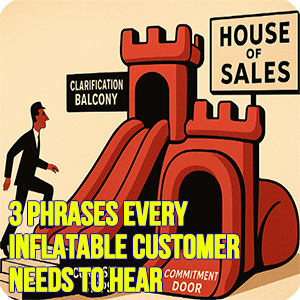
Based on a powerful metaphor – the “House of Sale” – selling is a journey. Trying to push the customer through the back door with a catalogue is the best way to watch them run to your competitor.
Imagine a house that is inviting to your customer. This is what your sales process should be like:
- The Stairs of Curiosity (Where you make them stop and listen)
- The Balcony of Clarification (Where you educate them and build trust)
- The Door of Commitment (Where you close the deal with clarity and no pressure)
Let’s build this house together.
1. The Stairs of Curiosity: The “Call” that Attracts the Right Customer
The secret that 95% of manufacturers ignore: never start by talking about your inflatable.
Think of the stairs as a sound bite. If you shout it in a room full of soft play centre owners or event companies, only those with the right problem will turn their heads and think, “Are you talking to me?”.
The Master Key: Only one thing sparks genuine curiosity: the business survival instinct. Your customer’s brain (whether a hire company or a theme park) is wired to pay attention to things that can increase profits, reduce headaches, or solve a common complaint.
Practical Examples for You, the Manufacturer:
- For Inflatable Hire Companies: “Did you know the most popular inflatable model is also the one responsible for 70% of emergency call-outs for repairs?” (This is a real pain for hire companies!)
- For Leisure Centres & Theme Parks: “Most parks are unaware of this simple safety rule that can reduce inspection time by 40%.” (This is operational survival!)
- For Event Entertainment Companies: “Tired of setting up the same bland castle at every birthday party and losing clients to those offering ‘something more’?”
My Recommendation: Gather your team. What is your customer’s biggest hidden pain? Is it maintenance? Low toy turnover? Lack of appeal? Your curiosity message must mirror that problem.
2. The Balcony of Clarification: The “Ah, I See!” Moment
Curiosity has opened the door. Now, the customer climbs the stairs and reaches your balcony. They don’t want a salesperson; they want a consultant.
This is the phase where you offer pure value, without selling. This is where you build authority and show you understand their business. The customer is silently asking: “How does this help me?”, “Does this manufacturer get my reality?”.
Your “Survival Kit” for the Balcony (Content That’s Worth Its Weight in Gold):
In the digital age, your balcony is built with:
- Detailed Blog Posts: “The Ultimate Guide: How to Choose the Right Fabric for Different Uses (Sun, Rain, Heavy Use).”
- Explainer Videos: “We Took Apart One of Our Inflatables to Show You the 3 Safety Stitches No One Talks About.”
- Video Testimonials: Satisfied clients explaining how your inflatable increased their revenue or reduced maintenance costs.
- Free Checklists: “5-Point Checklist for a Quick and Effective Daily Safety Inspection.”
Practical Example:
If your stair of curiosity was about breakdowns, your balcony content could be a free webinar: “The 5 Weak Points of a Cheap Inflatable and How to Spot Them Before You Buy”.
3. The Door of Commitment: The Clear, Fearless Invitation
The fatal mistake when closing a sale: being vague. “Would you like a quote?” or “Shall we send a sample?” are phrases that leave the customer in a sea of indecision.
At this moment, the person only has one question in their head: “Is buying from this manufacturer the right decision for my business?”
Your mission is to answer that question with a clear, confident, and reassuring phrase.
The Golden Formula (Adapted for You):
“If you’re tired of [SPECIFIC PAIN X], then [BUYING MY INFLATABLE/SOLUTION Y] is the right decision.”
Why does this work? It reconnects the action (buying) with pain relief (the customer’s problem). It provides a logical context that justifies the investment.
Practical Example of a Follow-Up Email:
If you have a hesitant client, send this email:
“Hi [Name],
It was great speaking with you earlier about your needs for the upcoming season. Let me be direct:
If your business is losing profit margin on inflatables that require constant maintenance and have a short lifespan, then investing in our ‘Professional’ line with an extended warranty is the right decision.
This will give you the peace of mind and profitability you’re looking for.
Shall we proceed with the order?”
Feel the difference? It’s clear, confident, and resolves the buyer’s anxiety.
The Takeaway: Be More Than a Supplier, Be a Partner
Most manufacturers build an incredible factory (a massive balcony) with an order door… but no stairs to lead customers to it. The result? No one ever gets to learn about your exceptional quality.
Your Immediate Action Plan:
- Identify the Real Pain: What is your customer’s business problem? It’s not “needing an inflatable”; it’s “needing an inflatable that doesn’t cost them money in repairs and downtime”.
- Build the Stairs: Develop 3 to 5 curiosity-driven phrases that mirror that pain and use them in your ads, website, and initial contacts.
- Prepare the Balcony: What valuable content can you create? A maintenance guide? A video on durability? Offer this on your website.
- Sharpen the Door: Train your sales team to use the formula: “If [problem], then [our solution] is the right decision.”
This isn’t a marketing trick. It’s a form of strategic communication. Stop selling inflatables. Start selling the solution to your customers’ business pains.
Inflated Greetings!
Did you like this content? To stay up-to-date with all the news, follow our social networks in the footer.