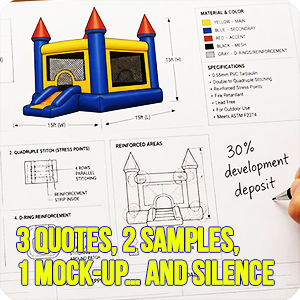
Your time costs you money. Stop giving it away to clients who will never buy.
There’s a type of client who seems like a dream – but it’s a pretence.
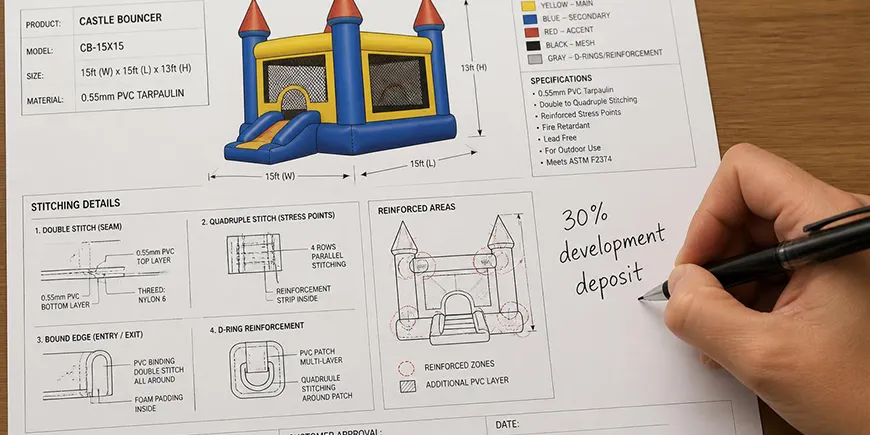
They ask for technical details. They want to know about PVC weight. They ask to see stitching samples. They compare digital printing with hand painting. They even visit your factory.
They’ll have coffee with you.
They say things like:
- “I really liked what I saw.”
- “I’ve got a big project coming up next summer.”
- “As soon as my business partner approves it, we’ll go ahead.”
And then?
Silence.
Or worse: a “I’ll think about it” followed by an order that’s identical to what you designed – placed with your competitor.
What happened? You gave away free consultancy. And they used your expertise as a blueprint to build their business – with another supplier.
Let’s sort this out. Without losing the sale. Without losing your dignity. And, while we’re at it, without losing any more hours that should be billing.
The vicious cycle draining your profit
Clients have learned that your know‑how is free
In most cases, it’s not malice. It’s opportunism.
If you offer a no‑commitment prototype, show them exactly where to reinforce the stitching, explain which PVC can handle 200 rental cycles instead of 50… they take notes. They take photos. They say thank you. And they take it to another supplier. A cheaper one. Without your development costs.
What to do?
Charge for the project. Not the final product – the project.
Practical example:
“Technical development including stitching specifications, design and print proofing costs €250 + VAT, which is fully deductible against your first order of 10 units or more.”
Anyone who thinks that’s too much? They’re not your client. Anyone who accepts it? They’ll value what they receive.
“I’m building trust” – no, you’re training the client not to pay
Every hour you spend designing, testing materials, tweaking prints without a guarantee of return is an hour you’re not producing for someone who already pays. At €40/hour (a conservative rate for skilled PVC stitching labour), a project that takes 10 hours is €400 of invisible loss.
This isn’t “customer service”.
This is subsidising the competition.
Ready‑to‑use scripts for every stage of the runaround
No begging. No “I completely understand”.
Use these responses. They’ve been tested by real manufacturers.
1. When they ask for “just a quick sketch”
The client: “Can you do a simple drawing for me to show my client? Just to get an idea.”
You:
“Yes, I can. Technical development including stitching and print specifications costs €250, deductible from your first order. If you’d prefer a quicker option, I can send you three of our standard catalogue models that we’ve already field‑tested – those have no development charge. Which works better for you?”
Why this works:
It shows you value your time. It offers a free route (standard models) for anyone who just wants “an idea”. And anyone who wants something customised, pays.
2. When they say “the quote is a bit high”
The client: “I like the project, but it’s about 15% above what another supplier quoted me.”
You:
“I can bring it down – if we adjust a few variables. For example: fewer PVC colours, a smaller model, or switching from printing to painting (with a loss in quality). I can also look at the timing if you’re happy to produce in low season. Which of these options would you like to explore?”
Golden rules:
- Never lower the price without changing the product.
- Never ask “who’s the other supplier” – that’s the language of someone in a weak position.
- If they say “I can’t change anything”, then the other quote doesn’t exist. It’s a bluff.
3. When they disappear after approving the prototype
You’ve sent the design. They said “I like it, let’s go ahead”. Ten days pass. Nothing.
You:
“Hi [name], to get this delivered before [relevant date: Easter, start of summer, Black Friday], I need to start the PVC cutting by Thursday. Please confirm the order by tomorrow, or shall we push it to the next production run (in three weeks’ time)?”
This does two things:
- Creates genuine scarcity (production lead time)
- Offers an honourable way out (next run) – they save face, you save time
The strongest move (for clients who’ve already burned you once)
If the same client has already pulled this trick – asked for work, disappeared, bought elsewhere – and comes back asking for a new quote, use this:
“Let’s be practical, because both your time and mine are expensive. Last time we invested eight hours of development and the order didn’t go ahead. For this new project, I can provide a quote subject to a development deposit of 30% of the estimated project value, fully deductible from the final order. If you’d prefer a simpler approach, I can send you only standard catalogue models, with no customisation. Which of the two options works for you?”
This isn’t aggressive. It’s fair.
Anyone who genuinely wants to work with you will accept. Anyone who just wanted another free quote to feed to a competitor will bow out on their own.
Between the Lines
Your greatest asset as an inflatables manufacturer isn’t your sewing machine. It’s your applied technical knowledge:
- Knowing which PVC withstands more cycles on a high‑turnover inflatable
- Where to reinforce stitching to avoid returns
- How to design for easier packing and lower shipping costs
- How printing interacts with the material in sunlight
And that knowledge cannot be free.
Serious clients pay for the project. The others pay with the time they stop stealing from you once they realise you won’t design for free.
Inflated Greetings!
Did you like this content? To stay up‑to‑date with all the news, follow our social networks in the footer.