
Forget “Pay When You Can”: The Foolproof Method for Getting Paid on Time Without Playing the Villain
If there’s one thing that keeps inflatable manufacturers up at night, it’s not a seam that’s split or a zip that’s jammed at three in the morning on a Saturday. It’s that message left on read. The infamous WhatsApp tick. The reply that never comes.
You did your best work. The vinyl was taut. The stitching reinforced. The pressure spot on. The bouncy castle was the star of the event. The kids laughed. The parents snapped photos.
And now? Now the telenovela begins – the saga of trying to get paid.
Let’s be honest: this article is for those who sell on credit. If you’re selling on delivery – cash in hand before the lorry leaves the yard – then you don’t have this problem. If that’s not your situation, perhaps it’s time to rethink your approach. Because a workshop doesn’t run on good intentions. It runs on money in the bank.
If you’ve ever found yourself chasing a friend, a relative, or that regular client who somehow “forgets” the arrangement every time the calendar turns, then consider this your financial survival guide.
Why “Being Flexible” on Payment Terms Is the Biggest Mistake You Can Make
Many manufacturers, especially those starting out, are terrified of coming across as “the bad guy” or “only interested in the money.” Here’s a hard truth: your business isn’t a charity.
Every day a client’s payment is late isn’t just a number in the red on your spreadsheet. It’s the PVC supplier who can’t be paid. It’s the sewing machine maintenance that gets put off. It’s your own wage – and your staff’s – that gets delayed.
When you “let it slide,” you’re not being kind. You’re teaching the client that deadlines don’t matter. Worse still: you’re telling them that your work, your time, and your expertise are worth less than theirs.
And that, my friend, is bad business.
The Workshop Doesn’t Run on Friendship: A Collection System That Works (Without Stress and Without Losing Clients)
Forget the generic message that 90% of manufacturers send:
“Hi, hope you’re well? Just a gentle reminder about the payment…”
That’s a shot in the foot. It’s weak. It’s begging. And it gives the client every excuse to keep ignoring you.
Let’s get down to it: a practical, direct, and psychologically smart system for getting paid. The technique we’re going to use is the backbone of any successful collection process. We’ll break it down into three stages.
Stage 1: Pre-Collection (Or How to Avoid the Drama Before It Even Starts)
The best collection is the one you never have to make. And that starts with the very first contact, during the negotiation.
Golden Rule: Never end a quote conversation with “pay when you receive it” or “we’ll sort it out later.” Set a date. Always.
“Payment should be made within 48 hours of delivery, is that okay? I’ll put that on the invoice to keep everything clear.”
Platinum Rule: Put it in a contract or a formal invoice. Yes, even for friends. And highlight the clause about late fees and interest. It doesn’t have to be an absurd amount – a 2% late fee plus 1% monthly interest is enough. The goal isn’t to make money from it. It’s to create a quiet reminder that punctuality is a serious commitment.
Stage 2: The Art of the Elegant Reminder (When the Deadline Is Approaching)
One day before the payment is due, send a friendly message. It’s the classic “making your point without looking like you’re making your point.”
“Hi João, how’s it going? Just checking in to make sure the delivery went smoothly and to let you know that tomorrow the invoice for our agreed job will be processed in the system. Any questions, just shout!”
Notice what you’ve done here:
- You haven’t chased. You’ve confirmed.
- You’ve positively anchored the date in their mind.
- You’ve shown that you have an organised “system.” That signals professionalism.
Stage 3: The “Two-Option Ultimatum” (When You’ve Been Left on Read)
Now the deadline has passed. The WhatsApp was seen. The client has vanished.
This is where 99% of manufacturers go wrong. They send increasingly polite, increasingly timid messages, until eventually they give up and swallow the loss.
And this is where you’re going to shine.
Do not ask “When are you going to pay?” That’s an open-ended question that can be answered with “next month,” “next year,” or “when the Lord provides.”
You’re going to close in with elegance. The answer lies in offering only two date options, both in the very near future. And preferably, with an amount slightly above what’s actually owed, to create a psychological trigger.
Here’s a practical example, adapted to your inflatable manufacturing business:
The Situation: A client owes £2,000 for a bouncy castle. The deadline was yesterday and they’ve disappeared.
The Wrong Approach:
“Hey mate, you okay? About that payment…”
The Right Approach:
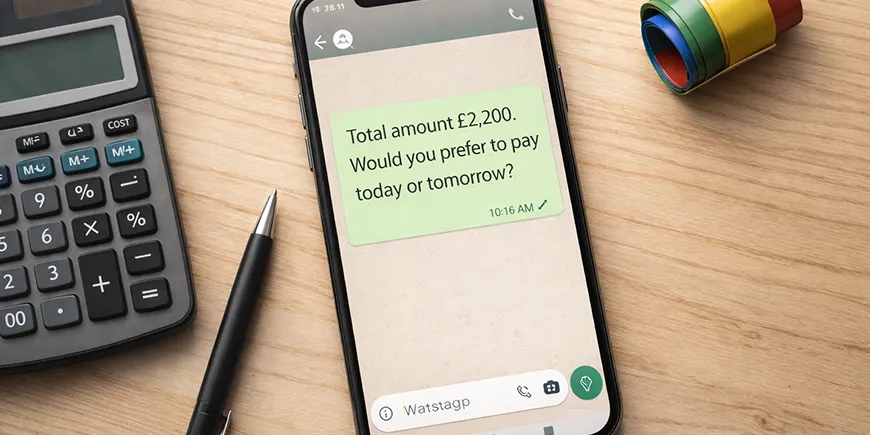
“Hello [Client Name]. Good morning. I’m currently organising the week’s cash flow. The total for order #1234 is £2,200. Are you able to make the transfer today by 5pm, or would tomorrow morning work better for you?”
What just happened?
- The trigger: They’ll read it and think, “Hold on, it was £2,000, not £2,200.” Immediately, they’ll respond to correct the amount. Bingo. They’ve replied. Contact is re-established, and the subject of “payment” is already on the table. The deliberate error in the amount forces interaction without you having to say “you owe me money.”
- The elegant ultimatum: They don’t have the option to say “next month.” The choices are “today” or “tomorrow.” The pressure is exactly where it needs to be.
- The proof: Now you have a formal conversation where they acknowledge the debt (by correcting the amount) and, by choosing one of the options, they’re agreeing to a deadline. If the saga continues, that’s a commitment made in writing.
What If the Client Is a Friend? Same Rules, Different Tone
No one wants to lose a friend over £500. But a real friend doesn’t want to harm you either.
The technique remains the same, but the language shifts.
Applying the technique for a friend:
“Hey [Name], hope you’re well. I’m just sorting out payments for the workshop and noticed your order for the [Bouncy Castle Name] is on the list. To help me settle up with suppliers this week, the amount came to £2,200. Can you sort it today or early tomorrow?”
Notice:
- No accusations. You’ve asked for help.
- You’ve used a legitimate reason: “settling up with suppliers.” Anyone running a business understands that.
- You’ve given the same two options.
If a friend gets offended by this message, the question you need to ask isn’t “how do I avoid upsetting them?” The question is: “does this friend truly want the best for me?”
Between the Lines
Chasing payment isn’t an act of aggression. It’s an act of professionalism and respect for your own business.
When you create a clear, direct, and human collection system, you’re not just protecting your cash flow. You’re also filtering out poor payers. Clients who take offence at a professional reminder are exactly the ones who intended to pay incorrectly or late. Good clients – the ones you want a lasting relationship with – understand and respect that. They have bills to pay too.
Implement the “Two-Option” system with the next late payment. You’ll see the magic happen.
Your time is your most valuable resource. Don’t spend it chasing what is rightfully yours.
Inflated Greetings!
Did you enjoy this content? To stay up to date with all the latest news, follow our social channels in the footer.


