
The Truth About What People Really Buy an Inflatable For
If there’s one thing a lot of people in the inflatables industry still haven’t grasped, it’s this: nobody wakes up in the morning wanting to buy a bouncy castle.
There it is. It stings the ego, I know. You spend hours choosing PVC, perfecting seams, testing blowers, and at the end of the day? The mum hiring the bouncy castle for her son’s birthday party couldn’t care less about your reinforced PVC or double-stitched seams.
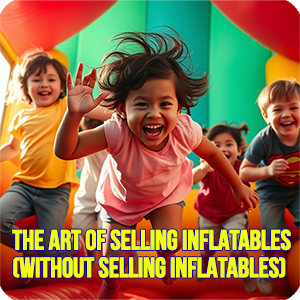
She wants one thing: to see a grin plastered across her little one’s face.
That’s it.
If you still think you’re in the business of manufacturing inflatable structures, you might want to sit down. Because, just like Starbucks doesn’t sell coffee, you don’t sell what you think you sell.
The “Good Product” Misconception
Let’s face it: the inflatables market is incredibly competitive. There’s a manufacturer on every corner promising the “best material,” the “strongest seam,” or the “lowest price.”
And guess what? All of that becomes a commodity within months.
If you’re competing on the basis of “my product is more durable,” congratulations: you’ve entered a race to the bottom. Because there will always be someone with a lower price and a promise just as good as yours.
The problem isn’t your product. The problem is that you’re selling the right product for the wrong need.
What Customers Are Really Buying
Let me tell you a story.
Imagine a first-time mum, let’s call her Sarah. She wants to throw a 3rd birthday party for her son. The theme? Paw Patrol. She spends hours on Instagram, looks at dozens of hire company profiles, and in the end, chooses the most expensive bouncy castle in the area.
Why? Because the most expensive castle had a photo from a recent party with a child absolutely screaming with joy. It had a comment saying: “My son refused to get out!” It carried the promise that, in that castle, little Leo would have the best day of his life.
Sarah didn’t hire an inflatable. She bought the certainty that, in the video sent to the family group chat, everyone would say: “Wow, what a fantastic party! Leo looks so happy!”
Sarah bought peace of mind. She bought the feeling of being a good mum. She bought the status of having thrown the best party in the playground group.
The Mindset Shift: What You’re Really Delivering
When you manufacture an inflatable, you deliver:
- Material
- Stitching
- Blower
- Instruction manual
But what the end customer buys (your customer’s customer, pay attention here) is:
- Safety (my child won’t get hurt)
- Entertainment (they’ll be occupied and happy for a few hours)
- Memory (this will be a photo for life)
- Status (my party was the coolest)
See the huge gap?
The hire company, your direct customer, buys revenue from you. They want a castle that works 30 weekends a year without issues, that turns heads in the street, that makes a child tug on their mum’s arm shouting “I want that one!”.
They don’t buy PVC. They buy their money-making machine.
The Masterstroke: Stop Being a Manufacturer, Become an Experience Enabler
If you want to stand out from the crowd and stop haggling over pennies on the final price, start changing how you communicate what you do.
What You Need to Show:
| You Say | The Customer Hears |
|---|---|
| “Industrial reinforced stitching” | “It won’t rip mid-party and leave me in the lurch” |
| “520g PVC” | “Durability that pays for the investment” |
| “1.5hp Blower” | “Total safety, no risk of deflation” |
| “Exclusive design” | “No one else in the area has one like it, I’ll get more hires” |
See? You’re not talking about inflatables. You’re talking about safety, return on investment, and exclusivity.
How to Apply This to Your Business
Enough chat. Let’s get to the point: how do you put this into practice tomorrow morning?
1. Change Your Catalogue Copy
Instead of “We manufacture castles with double stitching,” try:
“For the hirer who wants zero hassle: inflatables that withstand 30 weekends a year and still look like new.”
Instead of “Exclusive design,” try:
“The inflatable that will make your business the main attraction in your area.”
2. Tell Stories, Not Specifications
Your customer (the hirer) wants to know how they’ll make money. Tell them.
Create content showing:
- A hirer who paid off their investment in 3 months
- Children having fun (with permission, of course)
- How easy they are to set up and clean
3. Create an Identity
Starbucks sells expensive coffee because they create an environment where people feel sophisticated. You can sell more expensive inflatables because you create the feeling that the hirer is making a smart investment, not just buying a piece of equipment.
Between the Lines
You’re not in the fabric and stitching business. You’re in the business of throwing great parties, creating memories, and making your customer’s money work for them.
When you understand this, price stops being an issue. Because nobody questions the cost of making a dream come true. They question the price of a lump of plastic with a motor.
The choice is yours: keep selling PVC or start selling what really matters.
Inflated Greetings!
Did you like this content? To stay up-to-date with all the news, follow our social networks in the footer.