
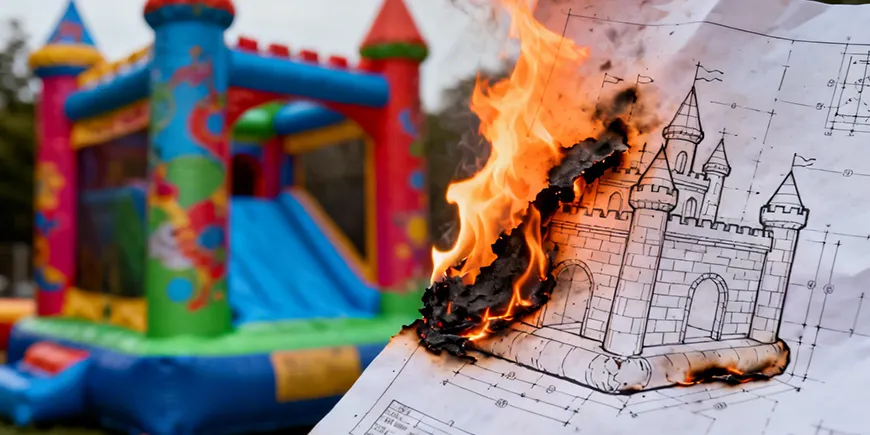
The Industry Blueprint Exists to Be Disrespected. Here’s Why.
A few weeks ago, I was catching up with a former business partner who runs a medium-sized production company. His thing? Making films and documentaries. Over coffee, we started dissecting the industry and he, in a moment of brutal honesty, laid out the complete blueprint for me. The absolute basics that every production house follows to the letter.
He showed me step A, step B and step C. The magic formula for delivering a project on time, with acceptable quality and the predicted profit margin.
When he’d finished, all chuffed with the sheer logic of it all, I looked at him and said:
“Right, brilliant. So now you know exactly what not to do.”
He stared at me like I’d just suggested filming a documentary underwater without scuba gear.
“What do you mean? But this is how everyone does it!”
My answer was simple:
“Precisely why you shouldn’t do it that way.”
And this little chat contains the single biggest strategic lesson any inflatable manufacturer could learn today.
The Gilded Trap of “That’s How It’s Done”
In the inflatables world, the temptation to copy is enormous. And I get why.
After all, the market seems predictable:
- You make a castle.
- You make a slide with a pool.
- You make a giant obstacle course.
- You sell it to the nearest hire company at the most competitive price.
- Rinse and repeat.
Why reinvent the wheel, right? If Dave’s castle down the road sells like hot cakes, why not make the same one? Why not copy the business model, the design, the whole catalogue?
Because, my friend, if you want to do the same as everyone else, the others are already there. And usually, the ones who got there first do it rather well. Copying the industry blueprint is the fastest route to becoming a commodity. It’s a cast-iron guarantee that when a potential customer wants a quote, they’ll ring you, they’ll ring Dave, they’ll ring Derek, and the final decision will come down to 50 pence either way. It’s a race to the bottom where the only winner is exhaustion.
The Creativity That Actually Counts (Not the Artsy Kind, the Strategic Kind)
When I talk about not following the blueprint, I’m not suggesting we all start painting castles in psychedelic colours or adding ridiculous features. That’s artistic creativity.
The creativity I’m talking about is business creativity. It’s the ability to look at a process, a market, a go-to-market strategy and ask:
“Why does it have to be this way?”
For an inflatable manufacturer, strategic creativity might mean:
Rethinking the Product:
Instead of churning out another generic castle, how about creating an exclusive themed range? A partnership with local characters? A series of educational inflatables for schools? A product designed specifically for a neglected niche, like corporate team-building events, with obstacles that mimic company logos?
Rethinking the Business Model:
Instead of just selling the equipment, how about selling the concept? Offering an event design service? Creating a partnership programme where hire companies pay a franchise fee for exclusive access to your designs in a particular region? Or, going the other way, selling directly to the end consumer through an online hire model managed by you?
Rethinking Communication:
Instead of showing photos of inflatables in a catalogue, how about showing videos of kids having adventures? Instead of talking about reinforced PVC, how about talking about the fond memories you’re helping to build? Instead of sending another sales email, how about sending an invitation for your clients to come to the factory and design their own model?
The Question Worth Its Weight in Gold
This ability to question what already exists is probably the biggest competitive advantage you can have. It’s critical thinking applied to business.
If everyone’s going right, maybe the fastest route is left. If everyone’s offering discounts for bulk orders, maybe the difference-maker is offering a loyalty scheme with exclusive perks. If everyone’s copying everyone else’s designs, maybe the way forward is to patent yours or create a style so unique it’s instantly recognisable as yours.
So, What Makes People Follow the Crowd?
This is your final question, and the answer’s a complex one, but it always comes back to the same thing: fear.
Fear of Getting It Wrong:
Following the blueprint gives a false sense of security. “If they did it and it worked, it’ll work for me too.” They just forget that the market that worked for them isn’t the same one any more.
Fear of Effort:
Questioning things takes work. It takes effort to think, to test, to mess up and to adjust. Copying is lazy. It’s just grabbing the mould and pouring in the PVC.
Lack of Vision:
So many manufacturers are so focused on cutting fabric that they forget to cut through the noise. They’re so deep inside the factory that they don’t see the world outside changing. They don’t realise that what they’re selling isn’t a product, it’s an experience of fun and safety. And experience? That can be reinvented every single day.
The safety of copying is a mirage. In the competitive desert of inflatables, those who follow the caravan die of thirst, all fighting for the same oasis.
Real abundance lies in uncharted territory. In the design nobody’s seen. In the business model nobody’s tested. In the strategy that challenges A, B and C.
Now, grab that critical thinking and ask yourself: what’s the first “A” in your company’s blueprint that you’re going to stop doing tomorrow?
Inflated Greetings!
Did you like this content? To stay up-to-date with all the news, follow our social networks in the footer.