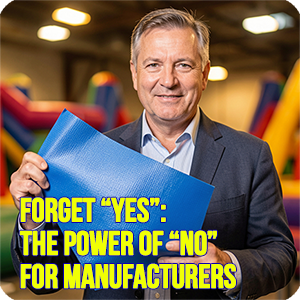

The “Yes” Myth That’s Destroying Your Margins
How many times today have you found yourself chasing a “yes”? In an email to a children’s play centre, in a meeting with an event organiser, while trying to close a deal on a new range of bouncy castles?
We’re hardwired to believe that “yes” is the holy grail of persuasion. That a customer who says “yes” is a customer won. That a manufacturer who hears “yes” is a successful manufacturer.
What if I told you that’s completely wrong?
What if that relentless pursuit of “yes” is actually sabotaging your conversions, pushing away your best rental clients, and making you waste time on leads that were never going to buy anything?
The revelation comes from an unlikely source: Chris Voss, a former FBI hostage negotiator. In Voss’s world, where the stakes are life or death, the most important word isn’t “yes”. It’s “no”.
And for those who manufacture inflatables — a business defined by tight margins, endless customisations, and customers who sometimes seem to expect the work done for free — this lesson is worth its weight in gold.
1. Your (Terrible) Addiction to “Yes” and Why It’s Ruining Your Results
We’re addicted to “yes”. It’s instant validation, a sign we’re winning, proof the customer has approved the budget, that the ambitious 12-metre project with a slide and pool is actually going ahead.
But like any addiction, this one comes at a high cost.
Voss explains that when you force a “yes”, you create anxiety on the other side. The person becomes defensive, thinking: “What’s the catch? What am I signing up for? Is this manufacturer hiding something from me?”
A Practical (and Terrible) Marketing Example for Manufacturers:
You receive a quote request. You immediately reply with:
“Would you like to proceed with production of the 8-metre bouncy castle for next week?”
What’s the likely internal response from your potential customer?
It’s not “Yes!”. It’s “Of course I would, but what’s the actual delivery cost? What extra do I have to pay for the custom print? Is this another manufacturer promising unrealistic lead times?”
A forced “yes” breeds distrust. And what is marketing without trust? Nothing.
Voss makes a devastating point: if “yes” worked as well as we think, your success rates would be through the roof. He jokes that if you’re “batting 125” (a mediocre average in baseball) when you could be “batting 350”, you’re settling for mediocrity.
How many quotes have you sent this year that went unanswered? How many forced “yeses” turned into absolute silence?
2. The Simple Neuroscience: Why “No” Is the Manufacturer’s Superpower
This isn’t just philosophy. It’s neuroscience. And it applies perfectly to the world of inflatable manufacturing.
- “Yes” = Anxiety: When you push for a “yes”, you put the renter or the play centre on high alert. Their brain becomes overloaded trying to anticipate risk: Is the PVC material good quality? What about the seams, will they hold? What if the equipment fails on first use? Anxiety gets in the way of rational decision-making.
- “No” = Control and Safety: Paradoxically, giving someone the chance to say “no” returns control to them. They feel safe, respected, and finally able to think clearly. “No” is a protective shield that calms the brain and opens up space for dialogue.
By inviting a “no”, you’re not being defeatist. You’re being strategic. You’re creating the safe environment necessary for genuine collaboration.
And for an inflatable manufacturer, this is critical. Why? Because your business isn’t about selling a standard product. It’s about manufacturing equipment that will be used by hundreds, sometimes thousands, of children. Trust isn’t a luxury — it’s the only asset that truly matters.
3. How to Apply This Today (and Stop Scaring Your Customers)
The theory is nice, but let’s get down to business. How do you put this into practice in your factory day-to-day, in customer service, in emails and quotes?
The magic lies in reframing your questions. Instead of asking for a “yes”, ask questions that invite a safe, considered “no”.
Golden Tip: The first time you do this, it’s going to feel odd. Voss compares it to forming a new neural habit, like trying to swap which hand you use for your thumb and forefinger. It’s difficult at first, but with repetition — around 63 times, according to the Blue Angels pilots — it becomes natural.
Practical Examples for You to Steal and Use Now:
For Qualifying Leads (The Jack Welch Case)
- Typical Question (Addicted to “Yes”): “Would you like to schedule a meeting to discuss the 10-metre inflatable project?”
- Reframed Question (Inviting “No”): “Would it be a completely absurd idea to schedule a 15-minute conversation so I can better understand what you need in the inflatable?”
In Your Email Marketing (Call to Action)
- Typical CTA (Addicted to “Yes”): “Want inflatables with custom printing? Request your quote now!”
- Reframed CTA (Inviting “No”): “If you’re not interested in standing out in the market with exclusive-print inflatables, feel free to ignore this email. But if you’d like to see how we’ve helped manufacturers command higher margins through design, our portfolio is here.”
For Negotiating Deadlines or Payment Terms
- Typical Question: “Can you approve the 50% deposit by Friday so we can start production?”
- Reframed Question: “Is there any absolute barrier to the 50% deposit being approved by Friday?”
Notice the power in these questions. They disarm, they give control, and — most importantly — they filter out unqualified leads instantly.
The person who replies “no, it’s not absurd” is genuinely interested. Whoever replies “no, there’s no barrier” is ready to move forward. And whoever ignores or stalls? They were just price-checking and were never a real customer.
4. The Real Goal: Getting a “That’s Right”
If “no” is the key that opens the door, “that’s right” is the treasure room.
Voss explains that people say “that’s right” when they have a moment of clarity, when they feel you have truly understood them. It’s far more powerful than a forced “yes”.
And for an inflatable manufacturer, this moment is where the business stops being a transaction and becomes a partnership.
Imagine this scene:
A renter has spent 20 minutes explaining that they’ve had problems with other manufacturers: seams that burst after three months, delivery deadlines that weren’t met, print that faded after the first season.
You listen. Then you summarise:
“So, if I’ve understood correctly, what you really need isn’t the cheapest inflatable on the market. What you need is a supplier who sticks to deadlines without fail, who uses reinforced seams on all stress points, and who guarantees that the printed design holds its quality even after a full season of sun exposure. Is that right?”
The customer sighs and says: “That’s right. That’s exactly it.”
This is where true trust and the close happen. Not because you sold, but because they understood that you understand their business.
Between the Lines
Time to Detox
Your sales communication may be suffering from a “yes” overdose.
Stop pushing. Stop forcing. Stop sending quote after quote to leads who just want the lowest price.
Start giving control. Invite the “no”. Focus on truly understanding your customers’ challenges — the renters who need durability, the play centres who need safety, the event organisers who need impeccable deadlines — until they say: “That’s right.”
When that happens, the final “yes” is no longer a push. It becomes an obvious conclusion.
My Final Challenge (and a CTA That Uses the Concept):
If you think these techniques are too counterintuitive to work in the inflatable market, then forget everything you’ve read here.
But if you’ve read this and thought “That’s right. My sales approach might be creating more resistance than conversions…”, then perhaps it’s time to rethink your strategy.
And if you’d like to take this conversation further, you know where to find me. Unless you think that would be a completely absurd idea.
Inflated Greetings!
Did you like this content? To stay up-to-date with all the news, follow our social networks in the footer.