Why a Free Pressure Test Outsells a Discount
Have you ever noticed that, at a trade fair, the manufacturer offering a free set of ground stakes or a protective groundsheet tends to close more deals than the one who just shows a catalogue? That’s no coincidence. It’s psychology in action. In this article, I’ll show you how small gestures – tailored to the reality of PVC inflatable manufacturing – can turn a casual conversation into a signed contract.
The Power of Physical Touch in the Factory: Show the Material, Don’t Just Talk About It
When a potential customer (a rental firm or event organiser) visits your factory, the worst mistake you can make is to start with a PowerPoint presentation. The best move? Pick up a scrap of PVC with an exposed seam and place it in their hand.
Why it works: Physical contact with the material builds tactile trust. Studies show that products which are touched feel more “real” and of higher quality. And with inflatables, where seam strength and PVC quality are decisive, letting the customer feel the material’s thickness is worth more than any spec sheet.
Practical tip for manufacturers: Always keep cut samples (with exposed seams, reinforcements, and a bit of printed material) close to hand. Don’t leave them in a cupboard.
The Small Gesture That Triggers Reciprocity: Offer a Free Pressure Test
Imagine a rental customer asks you for a quote on ten inflatables. Instead of just quoting a price, say:
“Before we talk numbers, how about we test one of our models in your operation for a weekend, at no cost?”
What the science says: The principle of reciprocity is powerful. Anyone who receives something for free (even just a trial) feels an unconscious obligation to give something back. In B2B inflatables, that payback shows up as: priority when choosing a supplier, tolerance for small delays, and even acceptance of slightly higher prices.
Important: Don’t confuse this with a low-value free sample. A pressure test with a fully set-up inflatable running at a real event costs you something – but the return in signed contracts is disproportionate.
The Right Time to Present Your Proposal: Schedule Meetings in the Morning (and Avoid Just After Lunch)
It sounds basic, but most manufacturers accept any time slot. Big mistake.
In the morning, cortisol levels (the attention hormone) are higher. Your customer processes technical information better: PVC thickness, seam type, the advantages of digital printing over hand painting.
Hard data: Negotiation studies show that proposals presented before 11 a.m. are 37% more likely to be accepted without major counteroffers. After lunch, patience for technical details plummets.
Rule for manufacturers: Technical meetings (quotes, specs, deadlines) – mornings only. Social or follow-up meetings – afternoons are fine.
Light Conversation Before Talking Seams and Reinforcements: The First 5 Minutes Aren’t for Selling
Getting straight to the point with a customer you don’t know? Bad move. Start with some easy chat:
“Been having much wind in your area? We’ve been reinforcing our seams because of that.”
or
“I see you do a lot of summer events – we’ve got a PVC with UV protection that solves that.”
Why it works: Small talk lowers defensive tension. Your customer’s brain stops seeing you as a “salesperson” and starts seeing you as a “partner”. And a partner listens more carefully when you talk technical specs.
Real-life example: One Portuguese inflatable manufacturer started winning 30% more contracts after training their sales team to spend the first 5 minutes asking about the customer’s operation, rather than showing the catalogue.
Small Rewards Throughout the Buying Process: An Unlock System for Rental Customers
If you sell to rental companies who buy regularly, create a staged reward system. Forget “buy 10, get 1 free” (too big, it demotivates). Instead:
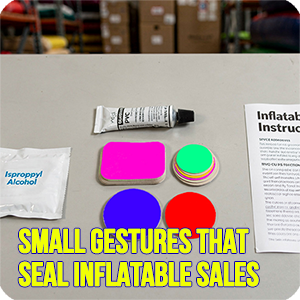
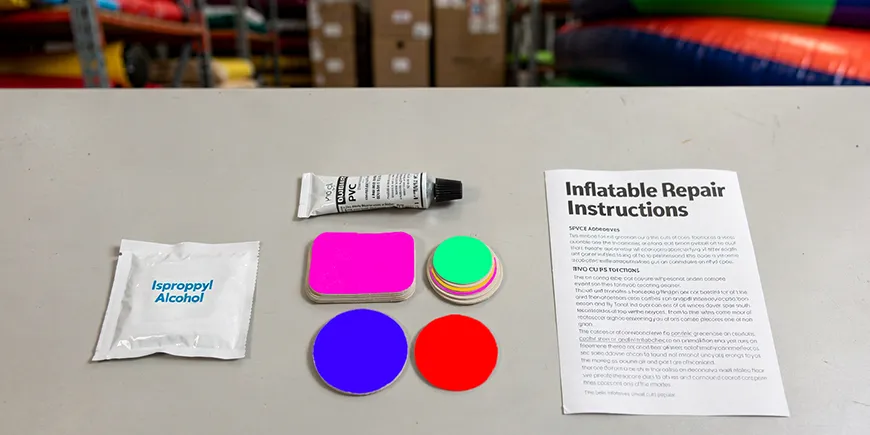
- 1st order → a small cut repair kit (PVC adhesive, matching PVC patches, isopropyl alcohol, and clear instructions)
- 3rd order → exclusive access to one model for 3 months (if you have agile digital printing)
- 5th order → discounted delivery for the whole year
Why the cut repair kit makes sense, but a seam kit doesn’t:
A rental customer isn’t going to sew an inflatable – that’s factory work. But a small cut in the base or side? That happens every week. Giving them the tools to fix it in 10 minutes turns them into a less dependent and more loyal customer. Cost to you: less than £2 per kit.
The Useful Freebie Strategy at Trade Fairs: Stakes or a Protective Groundsheet
At industry fairs, most manufacturers hand out pens or brochures. Mistake.
Offer something the customer will use the next day:
| Freebie | Cost to you | Perceived value | Why it works |
|---|---|---|---|
| Ground stakes (set of 4) | Low (strong metal or plastic) | High – they always get lost | Reciprocity + immediate usefulness |
| Protective groundsheet (inflatables base) | Medium (thick PVC, simple seam) | Very high | Differentiation + customer feels they’ve received something “serious” |
Tip for manufacturers: The protective groundsheet is your best freebie. It shows you understand the real problem (protecting children and the business). And it can be made from leftover PVC scraps from other production runs – near-zero marginal cost.
Important note: If you choose stakes, laser-engrave or permanently print your logo. If you choose the groundsheet, print your logo discreetly in one corner.
The Psychology of Presenting Your Inflatable: How to Show Your Product to Look More Robust
How you present your inflatable in a catalogue, video, or photo influences the perception of quality.
| If you want to convey… | Do this |
|---|---|
| Robustness and durability | Shoot the inflatable from a low angle, with the seam clearly visible in the foreground |
| Lightness and easy setup | Shoot from above, with a person holding the folded material |
| Impressive size | Place a person next to it (human scale) |
| Print quality | Side close-up with raking light |
Common mistake: Showing the inflatable empty, with no scale references or visible seams. The customer can’t tell if it’s flimsy or tough.
For manufacturers using hand painting vs. digital printing: If you use digital printing (more modern), highlight it in photos with sharp details. If you use hand painting (an older but still valid technique), associate it with “craftsmanship” and “full customisation” – that sells too.
Between the Lines
Selling inflatables isn’t just about having the best PVC or the strongest seams. It’s about how you make the customer feel during the buying process.
Offering a free trial, putting the material in their hand, starting with light conversation, using small rewards (with useful kits), and giving away freebies that solve real problems (stakes or protective groundsheets) – these are all low-cost, high-return gestures.
The science is on your side. Now all you have to do is apply it.
Inflated Greetings!
Did you like this content? To stay up-to-date with all the news, follow our social networks in the footer.