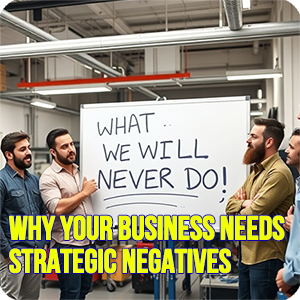

How Strategic Boundaries Forge Market-Leading Manufacturers
Every successful manufacturer knows that the quality of an inflatable begins long before the sewing machine starts. It begins with the fabric of your company philosophy. While most are busy figuring out what they can do to sell more, market leaders spend crucial time defining what they will never do, no matter the opportunity. These “Strategic Negatives” are not a limitation, they are the principle that ensures your brand doesn’t deflate under market pressure, remaining solid and recognised for its integrity.
Without these clear principles, it’s easy to fall into the dangerous cycle of accepting any order, lowering quality standards to compete on price, or copying others’ designs to please a client. The result? A generic brand, a production line with no standards, and a product portfolio that tells no cohesive story. Let’s build the foundations that will define not just what you manufacture, but who you are as a company.
Why a Manufacturer Needs to Know How to Say “NO”
In this business, saying “no” isn’t about losing a sale. It’s about gaining an identity. It’s the most powerful tool for making decisions that protect your profitability and your brand’s long-term strength.
Decision-Making with Laser-Cut Precision
Imagine a large potential client appears, but they request a model that falls completely outside your quality standard, suggesting the use of a thinner, less durable material. Without a clear principle, the temptation of the volume might win. Now, imagine your company has a principle: “We will never compromise the safety and durability of our products to compete in the low-price market.” That difficult decision instantly becomes easy. You haven’t lost a sale; you’ve protected your reputation and avoided a future problem. That “no” frees your team to focus on the clients who truly value the quality you offer.
Factory Culture: Attracting the Right Talent
A clear set of “Strategic Negatives” acts as a magnet for the right team. If you declare that “We will never be an environment where innovation is stifled by ‘that’s-how-we’ve-always-done-it’,” you attract creative designers and workers, eager to improve processes and create the next park sensation. Conversely, it repels those who prefer a more static environment. This self-selection saves costs on staff turnover and builds a cohesive team aligned with the workshop’s purpose.
Radical Market Differentiation
While most manufacturers shout “we do everything!” and compete on price alone, you can build a beacon. Think of the manufacturer who refuses to copy patented designs, focusing on creating their own original characters and themes. Or the one who publicly states: “We will never use materials that are not 100% non-toxic and easy to clean.” This positioning, defined by what you don’t do, attracts playgrounds, schools, and party centres that prioritise safety and originality – loyal clients willing to pay for value, not just price.
In Practice: Forging Your Factory’s “Charter of No”
Theory is good, but what matters is action on the production line and in the sales office. How do you implement this?
1. The “Client Nightmare” Exercise
Gather your key team. In 20 minutes, answer: “What is the worst feedback we could receive from a client three years from now?” The answers will be pure gold. Perhaps it’s: “Their toys are flimsy and break quickly” or “They copy others’ designs, they have no creativity of their own.” These nightmares are, in fact, your most important “NO’s”. Write them down.
2. Define Your Production “Non-Negotiables”
Turn those fears into pillars of action. Establish 3 to 5 sentences that will be the constitution of your factory.
- Example Focus on Quality/Safety: “Our workshop will never pursue an order if it means using low-strength seams or zippers that haven’t passed our pressure tests.”
- Example Focus on Innovation & Originality: “Our production line will never be a copy shop. We will invest in our own designs, even if it’s slower and more challenging.”
- Example Focus on Partnerships: “Our policy will never be to turn a blind eye to our distributors’ unfair trading practices, even if they are our biggest buyers.”
3. Communicate Your “Noes” Across the Entire Supply Chain
This “Charter” cannot be kept in a drawer. Internally, display it on the wall. Discuss it in meetings. When a new employee starts, they should know what kind of factory they are helping to build. Externally, use it on your website and in your B2B client portfolio. A statement like “Our commitment is to safety, therefore, we will never source raw materials from suppliers who cannot provide quality certificates” is not a limitation – it’s a seal of trust that builds stronger, longer-lasting business relationships.
Between the Lines
In the world of manufacturing, creative and operational freedom doesn’t come from a lack of boundaries, but from their clear definition. Knowing which toy you will never make, which material you will never use, and which client you will never serve, frees you to become the best manufacturer in your specific niche.
Your challenge is this: Take the specification sheet for one of your products and, next to it, write: “The Principles That Will NEVER Leave Our Mould”. List three. Be brutally honest. This could be the most important project your factory undertakes this year.
Inflated Greetings!
Did you like this content? To stay up-to-date with all the news, follow our social networks in the footer.